Showing posts with label proofread. Show all posts

Saturday, June 23, 2018

Finishing Touches!

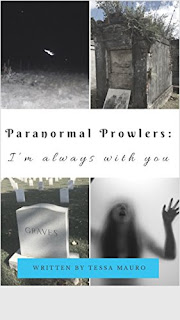
I've just finished editing this little gem from a wonderful lady, Tessa Mauro.

https://www.amazon.com/Paranormal-Prowlers-Im-Always-You-ebook/dp/B07DFRM6GL


Tessa Mauro is the founder of her team, The Paranormal Prowlers, which is based in Colorado. While out of her home state, she conducts solo investigations. Tessa has been a fan and a believer of the Paranormal since childhood and has been investigating it for the past several years.

Aside from being a paranormal investigator, Tessa has her own paranormal talk show Friday nights on worldwide radio, under the radio personality, DJ Prowla. Tessa spends her time between her two homes, in Colorado with her family and in North Carolina with her boyfriend and their two pets, Midnight the dog and Buttercup the cat.


If you love tales of the paranormal, this book is for you.

Join paranormal investigator Tessa Mauro on this odd and spooky ghost tour as she shares and talks about some of her investigations. Read the results her team, The Paranormal Prowlers, have collected throughout several years of conducting investigations at paranormal hotspots scattered around the United States.
The Paranormal Prowlers conduct investigations with respect and do not use provocation such as you often see on TV shows.
Almost never … the one time that Tessa provoked at her favorite location—Tombstone—she ended up with an horrific attachment that stayed with her for over a month, changing her life forever.
Sit down, leave a light on and prepare to enjoy the delicious thrills that this book delivers.


Monday, April 16, 2018

Editing for Indies

When you start out writing you have the world at your fingertips. You, and you alone, decide what happens in your world and then you finish your book.

What comes next?

Your masterpiece is ready to face the world. Where do you begin? You do a little research and the whole process starts to snowball.

  • Do I need an editor?
  • What's a beta-reader?
  • Who will proofread my book?
  • How do I layout the book?
  • Are the digital and paperback formats the same?
  • Where can I find artwork or photographs for my book cover?
  • Who will do my book cover for me?
  • Where do I sell my book?
  • What's a blurb?
  • How do I even begin to market my book?

Answers

The answers to all these (and many more!) questions are to be found online. All the major online booksellers have excellent help pages and if you are prepared to wade through these, you will be able to get your masterpiece into your hands without having to spend a lot of money.

Marketing

After you have uploaded your masterpiece, you will most likely sit and watch the sales graphs - or as many new indie authors call them, the no-sales graphs - hoping that your book will suddenly take off and hit the bestseller lists.

What do you have to do to get the money to start rolling in?

  • Increase your book's visibility - social media, blogs, advertising
  • Tweak your book description - identify your readers and make sure your description fulfils their needs
  • Make sure your book cover is the best it can be
  • Research your tags to gain maximum exposure
  • Ensure that your book is in an appropriate category and sub-category
  • Ask for reviews
There are many other ways to help kick-start your book sales. Research - and lots of it - will help you get your marketing campaign up and running.

Keep up the marketing! There is so much competition out there that it is essential to keep coming up with fresh ideas.

It is possible to go it alone and if you are willing to put in the effort it can prove rewarding.

However,

If you find the process overwhelming and would like some help and advice drop me an email and I will be happy to talk to you about ways I can help - without breaking the bank!

Kim O'Shea

info@kimoshea.com


Thursday, September 28, 2017

Don't murder your prose!

As authors we aim to write great content that is easy to understand, clear, and grabs and holds attention. Sometimes our language lets us down and instead of exciting, attention-grabbing words, we use plain, boring and uninteresting ones - simply because we are used to using them.

Bad language


The main language killers are those modifying words: adverbs and adjectives. Instead of improving our writing, they can deaden it and make it boring and dull.

He ran quickly down the hill.

Ok, so he ran quickly down the hill. Right.
But, what if:

He raced down the hill.
or
He sped down the hill.

Now, we can feel the action.

How about . . . ?


Peter looked at her lovingly.

Sounds ok? He looked at her lovingly. Boring!

What if:

Peter gazed into her eyes.
or
Peter reached for her hand as he looked at her.

Now we can see his love for her without being told. Much more romantic!

The little word very can cause problems too.


Mary was very tired.
But, what if, Mary was exhausted? Or Mary was weary.

The elephant was very big.
Or, was the elephant huge, enormous, massive?

Always check your writing for words such as these. A simple change is all it takes. It can make your readers want to turn the pages, want to find out what's coming next and want to read your next book.

A trifling change can make an enormous difference!

For a free quote for editing or proofreading contact me info@kimoshea.com


Wednesday, September 27, 2017

Common Errors

There are many common errors to watch out for when editing or proofreading. The following list covers four of them;
  • Transposition
  • Grammar
  • Spelling
  • Wrong meaning

Transposition

This happens when letters are transposed or swapped around in a word;
  • from / form
  • cat / act
  • Wedensday / Wednesday
  • public / pulbic
The first two errors can only be found through careful reading of the document as the incorrect versions are still words and will pass the spell checker.

The last two mistakes are easier to find as any good spell checker will immediately pick them up.

Grammar

These are too numerous to mention here in detail, however, four of the most common problems are;
  • their, there, they're
  • its, it's
  • plurals of nouns (apostrophes are for the possessive case NOT plurals)
  • passive voice.
For the correct use of the first two sets of items, consult a grammar book or online resource.

Plurals of most nouns are formed by adding s NOT 's.

The passive voice should be used sparingly - it does have its uses.

Passive - 'The boy was bitten by the dog, Active - ' 'The dog bit the boy.'

The active voice can
  • remove doubt
  • move the action along
  • create tension
  • keep the reader engaged.

Spelling

There are always words that catch us out. Make a list of the words you find you have trouble with, time and again.

  • separate / seperate
  • millennium / milennium
  • licence / license
  • current / currant
The spell checker will catch the first two but the second two are spelled correctly but may not be what is meant - a current bun means a bun that is fresh or up to date, while a currant report means a report on a currant!

Wrong meaning

If you are in doubt, check the definition!
  • illusion / allusion
  • effect / affect
  • ingenuous / ingenious
  • uninterested / disinterested
There are many words similar to these. Make lists of the ones that give you trouble.

Editing and proofreading are skills that can be learned but if you don't have the time, give me an email for a free quote info@kimoshea.com


Monday, September 18, 2017

The Biggest Turn-Off

With companies and businesses turning away from traditional advertising and turning towards social media advertising, the risk of errors and mistakes being published increases each day.

Scan through your social media feeds. There is a high chance of you noticing at least one (and sometimes far more than one) mistake in an otherwise excellent advertising campaign.

Poor spelling, wrong punctuation and incorrectly worded copy all serve to damage the image of the brand in question.

Does it matter?

Yes! Potential clients need to trust businesses before they will commit to an order. Even small errors can make a client wonder just how professional the people behind the business actually are.

Competition means that there is always another company or business waiting in the wings to swoop in and grab that potential client.

Don't lose clients through something as simple as a spelling error!

Contact me today for a free quote. Email info@kimoshea.com

Helping Businesses One Word at a Time


Monday, September 4, 2017

Whe Needs Proofreading?

I've heard people say that only serious writers need proofreaders. Even if that were true, what makes a serious writer?

In the media, the word writer often conjures an image of a solitary figure bent over a laptop in a lonely upstairs room, looking out over the countryside as they wrestle with the next word.

In reality, writing has come a long way and a lot of writers do not consider themselves to be writers!

There are so many types of writing!
  • books
  • magazines
  • journals
  • reports
  • letters
  • emails
  • proposals
  • presentations
  • blog posts
  • advertisements
  • signage
  • social media posts
This list goes on.

For any business to be professional, all of these communications need to be checked carefully. A simple error in a report can drastically change the whole focus of it or an incorrectly spelled word in a sign can be a source of embarrassment.

While it is not always essential for every piece of writing to be checked, good business practice dictates that care should be taken over every communication and this is where proofreading can be so important.

So if you think you don't need a proofreader, think again! It's your business, so always put your best foot forward!

For a quote, contact me: info@kimoshea.com


Friday, September 1, 2017

Proofreading 101

How do you go about proofreading your own content?

There are a few things you need to remember before you start
  • You are familiar with your content and will read it as you want it to read, not necessarily as it's written
  • Proofreaders are trained to catch errors and to know what to look out for
  • At the very least you will need to get a friend or family member to read through your content after you have finished, to see if they can catch any further errors
  • 'It will do' never does! If you catch an error you must resolve it even if it means rewriting or reworking part of the content
  • Proofreading is also about the look and feel of the piece. A beautifully written piece with bad layout or a great idea that is poorly presented will never be taken seriously
  • Put enough time aside to finish the job - a trained Proofreader averages 10 pages of 300 words per hour but that depends on the content and the type of proofreading needed
  • Take regular breaks to prevent eye-strain or tiredness both of which will affect your concentration.
The first thing you need to do is run the piece through a good spell-checker. If in doubt about any suggested changes, look them up in the relevant dictionary (depending on what language style is being used - Oxford English, American English, dialect, jargon etc.)

Using software like track changes in Word begin to go through your document amending errors as you find them. (Using track changes allows you to go back and see the original if you decide later that you are still not happy with the change).

When you are happy with your change, hit accept all and move to the next stage.

After this is complete and you are happy with the changes, print off the document (unless you are proofing a website or very short content) as it is easier to see mistakes on a hard copy.

Read through the piece (I suggest paragraph by paragraph) aloud. This will give you a good feel for the piece and will help with pacing as well as grammatical errors or realising that another word would work better.

Mark your changes as you go using proofreading marks for brevity and clarity or short notes near the change you wish to make.

When this is complete you will need to transfer your changes to the document.

After this, either print off the document again or send it as a pdf or mobi file to a friend or family member to read through.

If you have come this far, Congratulations! Your document is nearly ready to go.

When you get the document back from your reader, take note of any changes they request and if feasible or necessary, carry them out.

At last! You should be good to go! Well, nearly.

A few more things!
  • check all the document formatting
  • make sure that any pictures are where they are expected to be and are captioned correctly
  • establish that footnotes are referenced correctly
  • confirm that references are correct
  • ensure that headings and /or subheadings are sized consistently
If this seems like hard work, it is!

Why not contact me for a quote today? info@kimoshea.com


Wednesday, August 30, 2017

6 Reasons to hire a Proofreader

Sometimes we think, 'it'll be fine!' Sometimes we think, 'I got this!'

Other times we know we need help.

Here are 6 good reasons to check everything and then check again!

Proofreading! It really does matter!

Proofreading

Online proofreading

Editing services

Proofread

Book Proofreader

Proofreading work

Don't take any chances! Contact me today: info@kimoshea.com


Sunday, August 27, 2017

Checking for Errors

Indie authors usually struggle to find money to pay for cover design, editing, proofing or marketing. Each of these steps is essential, so what can you do?

Cover Design


A good cover sells a book. Well, it certainly helps! It's the first thing your potential buyers will see so try to make it the best you can.
  • Find a friend who is good at graphic design
  • Use fiverr.com
  • Teach yourself Photoshop.
The first option is great as long as the friend knows what they are doing and can work with you to design a great cover. Your input is essential as you are the only one who knows your book intimately. Make sure you mock up several covers so you have a few to choose from.

The fiverr.com option is another good way to go. Check portfolios carefully and see what you think of their work before you decide on the producer. Also check any reviews or comments left by previous clients.

If you are creative (well, you've written a book, haven't you?) and have a good eye for colour and design, you could use YouTube videos to teach yourself the appropriate design software - you'll also have to buy the software!

Whatever you decide, before you release your book, join some Facebook writers and readers groups and post your proposed cover. Ask for honest criticism (you'll get plenty) and once you have narrowed it down to two or three choices, run a poll in the group to help you decide. The cover you prefer may not be the one that everyone else likes so be prepared to compromise - after all, you have asked for their opinion and they have given it freely! As potential buyers, their opinions are very important.

Editing and Proofing


If you really can't afford a professional there are some essential things that you must do before releasing your book.
  • Do a spell-check
  • Print off the book
  • Check that margins, headings, fonts and page formatting are consistent
  • Read the book aloud
  • Read the book again, this time slowly, word for word.
Spell-check will help to catch spelling errors but will not differentiate between transposed words - form instead of from etc.

It is easier to check the margins and other layout issues by turning the manuscript upside-down (this reduces distraction from the words on the page).

By reading aloud you can check the pacing of the work and also take note if any of the sentences or passages seem overly complicated or confusing.

A final, slow read will (hopefully) catch any further errors.

Marketing


Many books have been written on the subject of marketing and there are hundreds of excellent blogs and articles on the web. Simple searches will get you started. All successful authors will tell you that the best method of marketing is to build your email list.

Start on the list as soon as possible and keep building - never stop!


Always remember, a final proofread can save embarrassing reviews and help build trust with your readers.

For a free quote, contact Kim at info@kimoshea.com


Friday, August 25, 2017

Can Authors Proofread their own Work?

The short answer is 'yes'.

But ...


It is very difficult to proofread our own work. As the author, we are so familiar with the piece that our eyes tend to skip what is actually there and to read what we expect to be there.

Editing and Proofreading can be too expensive for struggling indie authors so what should we do?

There are a number of things that will help us to catch  most errors:
  • Put the document away for a few weeks and don't look at it
  • Use the writing programme's spell-check function
  • Print off the piece and check the formatting and the 'look' of the piece
  • Read the document out loud
  • Get a pencil and read again, this time, one word at a time
  • Correct all the errors you have found and run the spell-check function again.
Be aware of some of the most common errors:
  • Incorrect or changing verb tenses (if writing in the past, use the past tense etc.)
  • Subject and verb not agreeing (The club is meeting today)
  • Words spelled correctly but not the intended word (from - form etc.)
  • Incorrect use of the apostrophe or comma (It's, its etc.).

If in doubt, correct as many of the errors as you can find and then if you are still unsure, get a quote from a Proofreader for the final review. As you have already done a lot of the work, it may not be as expensive as you think!

Remember, a first impression is only made once. Make sure your first impressions are the best you can make them.


Contact Kim at info@kimoshea.com


Wednesday, August 23, 2017

Test your skill

Have a go at proofreading the following piece and leave a comment when you think you have found all the mistakes.

Perhaps you'll find more than me!


Sam looked up as he walked under the tree. Dead leaves rustled under his feet and disturbed the bird sittting on a branch watching him.

As the bird flew away, Sam sighed. He had hoped to get a close - up of the bird but now his chance was gone. He lowered his camera and was about to put the lens cap back on when, he saw the bird again.

It was sitting on a fence post not too far away . He quickly readied the camera, and took six shots in in rapid sucession.

Success! At last he had a picture of this rare specimen. He couldn't wait to go home and upload it to the group page! They will be very jealous of his sighting! If only he could get a little closer and catch the delicate colours of the plumage!

He moved slowly towards the bird holding the camera in front of him, ready to get that unforgetttable shot.

The bird put it's head on the side and watched him as he got closer. Sam cautiously checked the zoom and prepared to get the elusive picture. He couldm't believe his luck! The bird continued to watch him but didn't move!

Sam brought the camera slowly to eye level and placed his finger on the shutter release buttton. One click was all it would take and he would have the picture of the milllennium .

He begun to apply pressure with his finger when a suden noise shocked him. As he watched, a cat leapt on the unsuspecting bird and ran off with it in it's mouth.

Later as he downloaded the pictures Sam, found he had caught a perfect picture of the cat at the second it grabbed the bird.

The cats eyes were focused firmly on Sam and to Sam's surprise, he could have sworn that the cat was laughing at him.

Have fun and don't forget to comment below!


Monday, August 21, 2017

The Apostrophe Crisis

It's every Proofreader's nightmare. It lurks, unnoticed by some and an affront to others. It pops up in unusual places, at the most surprising of times.

What am I talking about? The errant apostrophe, of course.

Sometimes called the Greengrocer's apostrophe, this specimen leaps out from shop windows or roadside signs.

Cabbage's for sale.

Cabbage's what for sale, I hear you asking? Has Cabbage got some prized possession he's trying to sell? This type of sign is guaranteed to raise the blood pressure - either from frustration or excitement (after all, cabbage may have something he wants to sell!).

Then there is the other one.

The one that can't differentiate between there, their or they're.

Admit it! This one really gets to you!

And what about ... wait for it!

its, it's.

Some people find it's difficult to get it in its rightful place. (Whew! You thought I was going to do the unthinkable there didn't you?)

You're going to love your next one.

Did you see what I did there? Yes. The infamous you're and your.

For anyone who's still struggling, here are the rules:
  • An apostrophe is used to indicate possession or replace a contraction. It is NEVER used to indicate a plural! - That is one of Mary's cats. Don't trip over it!
  • There - a place. Their - belonging to them. They're - they are.
  • It's - It is. Its - possessive form of it.
  • Your - possessive form of you. You're - you are.
And one more I haven't mentioned as we (thankfully) don't see it too often any more:
  • Whose - possessive form of whom. Who's - who is.
So there you have it. The solution to the apostrophe crisis.

Share with your friends and family. Share with your workmates and colleagues. Share with your cousin at the other side of the world. But most importantly, share with your greengrocer. We need to stamp out this scourge.